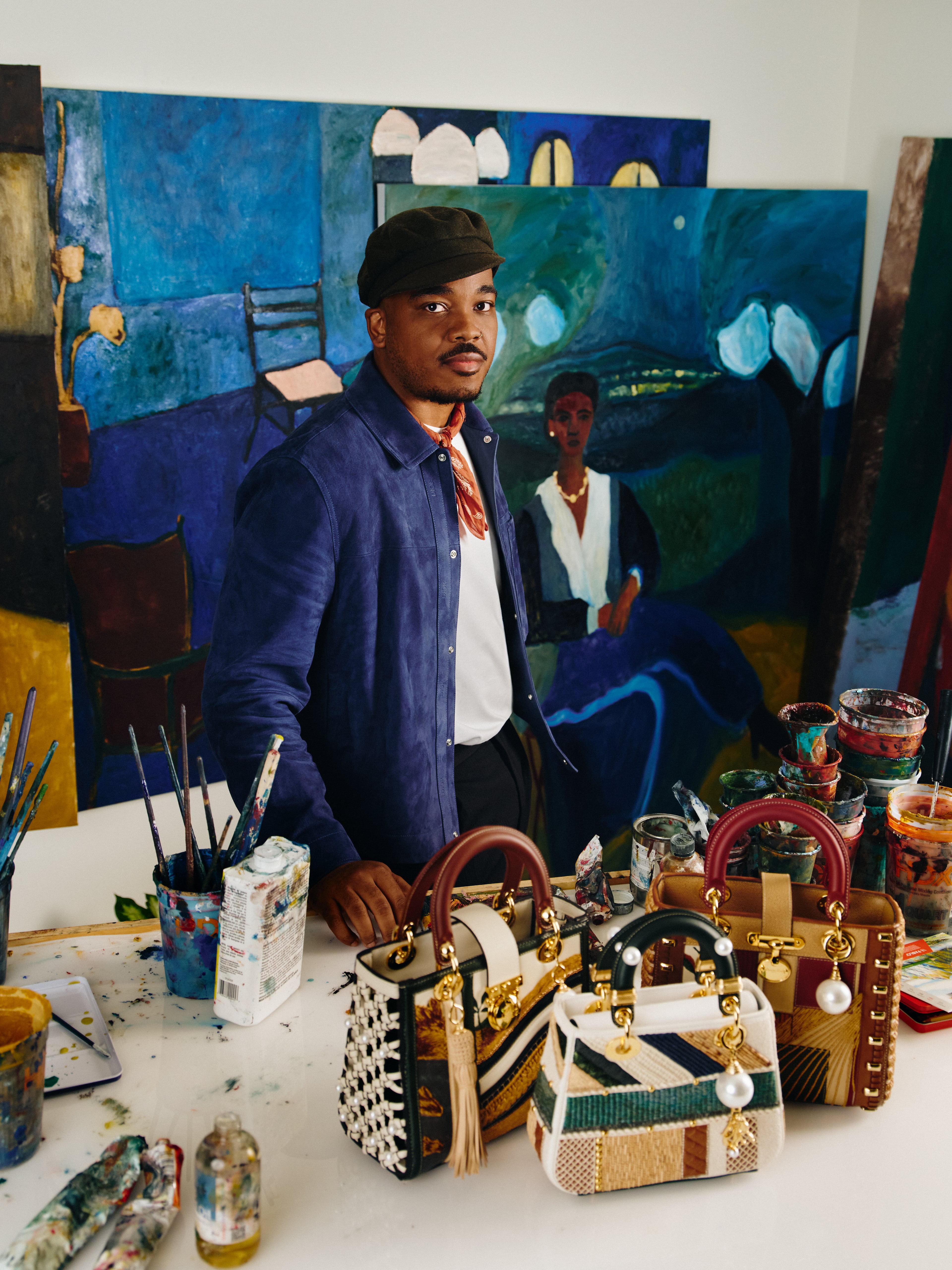
Patrick Eugène stands behind three handbags he designed as a 2025 participant in the 10th annual Dior Lady Art project. Only 10 international artists, including just two American artists, were selected to reimagine the Lady Dior handbag as contemporary art. (Courtesy of Heather Sten)
Before becoming a figurative painter, Eugène spent 10 years creating abstract and experimental artworks that allowed for full-bodied spontaneity and improvisation.Like jazz (another love of his), Eugène paints as the spirit moves him. He meditates and prays before approaching a canvas, having faith that God or his ancestors will guide his strokes. On a coffee table in the studio is a book called “Flash of the Spirit,” which dives into African spiritual practices. “When I am done, I say ‘Thank you. I’m not sure exactly who you are, but I know we’re connected and I appreciate you showing up.’ … It’s a really intimate experience for me,” he said.
On a wall in the loft hung one of Eugène’s latest large-scale paintings in progress. A ladder rested to one side of it; a table covered in squeezed tubes of oil paint and well-loved brushes sat before it. The half-completed painting is one of several Eugène has been working on recently as part of a new, currently unnamed, series.The painting shows a handful of individuals of African descent with so-far undefined relationships. It’s created, Eugène said, on raw canvas requiring laborious effort to saturate its pores and bring color to the surface.
To the right of the half-finished canvas was another new painting of a couple, their bodies blurring where they merge in embrace cozy in their home.
Each bag thus has a pearl hanging from it and is made from materials that pay homage to Haiti, such as raffia, used frequently in Haitian weaving.

The first of the three bags, Eugène said, was inspired by Haiti’s rolling landscapes — hills like the ones his grandmother once enjoyed while eating mangoes and looking out over the land from her home near Port-au-Prince. On a housekeeper’s salary, she learned to invest and save and built her home with dreams of hosting her all her children and grandkids. She was forced to flee when the area grew too dangerous.
The second handbag evokes the essence of the Haitian Caribbean. It features hues of blue and is made with some see-through nets on its ends to honor Jacmel, an artist community and fishing village on the southern coast of Haiti.
The last design, Eugène calls the royalty bag. It is the most ornate of the three with gold details and an elegant flower. Eugène almost always incorporates a flower into his artwork to honor his mother, whom he gardened with as a child.
All three bags will be presented at Dior activations around the globe, including in the United States at Art Basel Miami, in Los Angeles and New York. Eugène will help celebrate his son’s 20th birthday by taking him to Art Basel Paris where Dior will also showcase the bags.
Eugène will be gifted one of each of his bag designs, then face the predicament of deciding which to give to his wife, and which to his mother.
Eschewing sitters or reference images, Haitian American artist Patrick Eugène paints portraits of people he’s never seen. A quintet of ladies in their Sunday best—a riot of church crowns, pearl earrings, and lace collars—with their arms loosely draped around one another, one lifting a cigarette to her lips with studied elegance. A couple, her red gown seeping into his cream suit, moving like a single body through a russet expanse accented with potted plants. A woman with an impossibly long neck—a creator, we are told—wearing a dress the color of swimming pools, nestled in a safflower armchair’s ample topography. These graceful, self-possessed subjects, all of whom are Black, exude a magnetic force. They may not exist in the flesh, but nonetheless elicit our investment in their interiority and curiosity about their stories, as if they were characters in a beautifully crafted novel whom we are prepared to follow to the very end.
“I want viewers to develop their own stories about these pieces,” Eugène tells me. “While my subjects aren’t people I know or have met, you could say we’re spiritually involved. Because they look related to one another and feel familiar to me, it’s almost as if I’m painting my relatives. I often have this experience of looking at the person who I’ve just painted and thinking, ‘You’re here! You made your way through the brush.’”
The closely watched artist, whose solo show Solitude opened at Mariane Ibrahim Gallery’s Paris location this February, came to painting later than most, at the age of 27. Born in New York to Haitian immigrant parents, Eugène grew up in Brooklyn and Long Island in a tight-knit community of Caribbean Americans, many of whom took pride in dressing impeccably and covered their walls with Caribbean art; these early aesthetic influences, he notes, inform his paintings today. During Occupy Wall Street, Eugène, then working as a financial planner, turned to drawing as a creative outlet. Encouraged by the positive feedback he received, he soon tried his hand at painting (first acrylic, then oil) and committed to an autodidact’s diet of museum visits, art books, and documentaries.
Eugène’s first Brooklyn solo show, held at BAF Gallery in 2016, featured spattered, mixed media abstractions that critiqued, and incorporated the material detritus of, gentrification in his East New York neighborhood, where slick new businesses were increasingly supplanting mom-and-pop shops. The pandemic lockdown prompted Eugène to relocate with his family to Atlanta, where he began to work in a figurative mode, branching out from (without ever really forsaking) the abstract paintings for which he was becoming known. “Abstraction set me free,” he says, recalling his initial surprise at finding he had worked 12 hours straight without eating. “I didn’t want to revisit figuration, which I worked with very early on, until I could feel that same kind of freedom with it.”
In the studio, Eugène doesn’t make preparatory sketches or elaborate underdrawings. Instead, he focuses on accessing a headspace conducive to creative work, typically putting on music (his youngest child is tellingly named Miles) and meditating or praying for guidance. “I want to accept ancestral energies and try to keep that channel open,” he says. “It’s part of why I paint.” His fluid and intuitive process, an art of broad strokes, begins with putting a ground on the canvas. After limning the figures and their environs, he tries not to spend too much time reworking or revisiting what he’s done. He avoids making changes to the subjects’ faces in particular.
Patrick Eugène shows one of his conceptual drawings for a handbag he designed for Dior's Lady Art project. The bag is inspired by the landscapes of Haiti and is built using fabrics like raffia to pay homage to his heritage. (Danielle Charbonneau/AJC)
On the far west end of the Goat Farm Arts Center, visitors can find a painted door beneath a rusted metal awning leading to the new art studio of Atlanta-based, Haitian American artist Patrick Eugène.
Eugène was selected as one of 10 international artists, and one of only two Americans, to participate in the 10th annual Dior Lady Art project, a project that gives select artists an opportunity to reinterpret the Lady Dior luxury handbag as a work of contemporary art.
“I spent so many years in experimentation that I feel like I’m always craving and have this urge to create objects again,” he said. “I always want to explore … I never knew I could paint until I was 27 years old. So who knows what else? … I wake up every day and I say, ‘Who knows? What else is there?’”
All three of the bags Eugène created will be presented at Dior activations around the globe, including in the United States at Art Basel Miami, in Los Angeles and New York. Eugène will help celebrate his son’s 20th birthday by taking him to Art Basel Paris where Dior will also showcase the bags.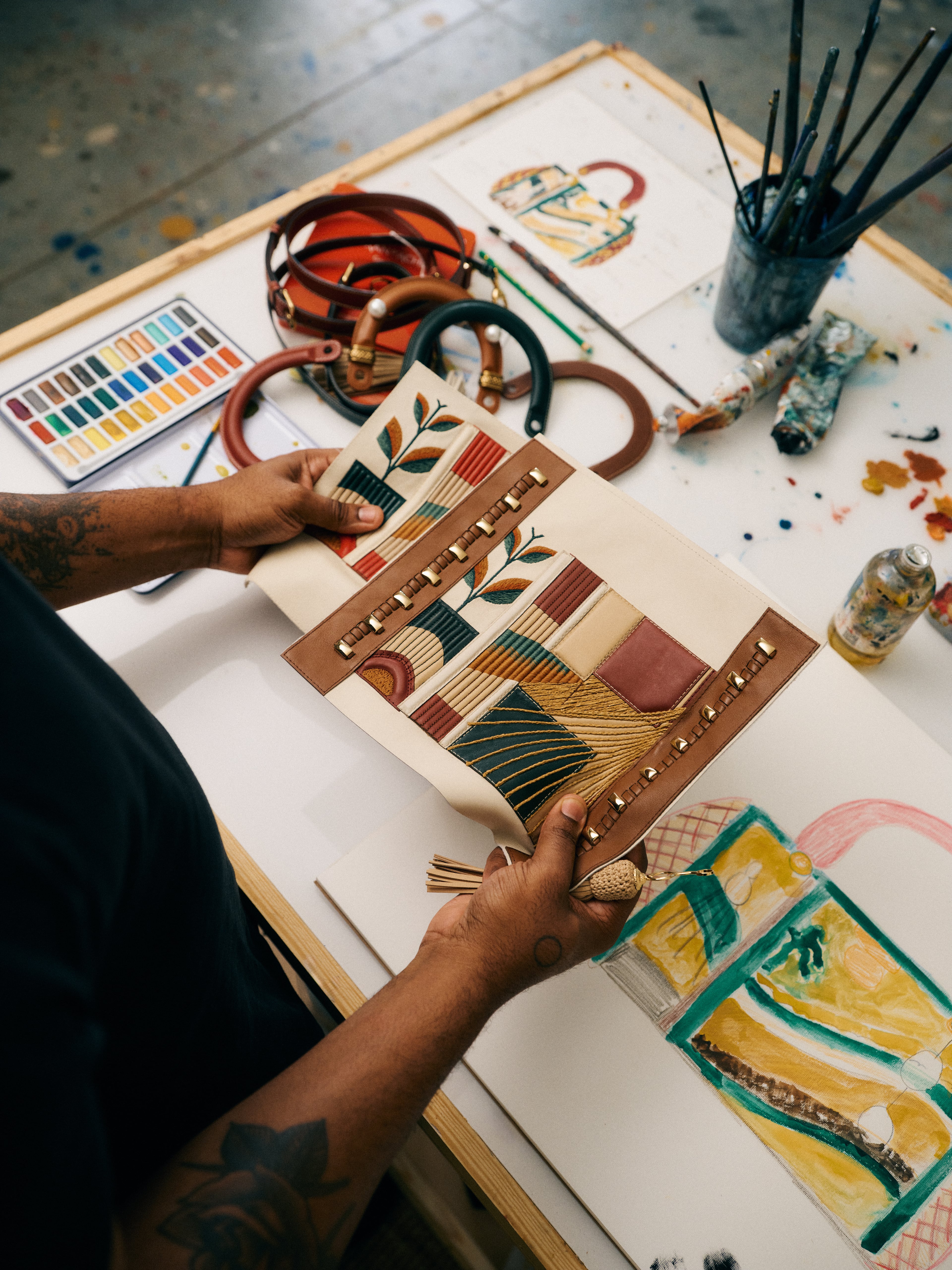

Comments